
The Beautiful Grift
What FIFA's corruption scandal teaches us about power, impunity, and the long game.

I spent most of my time these days reading books and watching documentaries about frauds, scandals, and corruption across a number of different contexts. In honor of the World Cup, it only seemed fitting that I do a deep dive into the FIFA corruption scandal from a little over a decade ago. Some of you might have followed it closely at the time; those were simpler days when I wasn’t glued to the news or my social media feed and so though I heard about it, I wasn’t on top of all the details. So I decided to watch Netflix’s FIFA Uncovered and do a little bit of digging around.
Hoo boy. This organization is a Piece. Of. Work. As far as I can tell, FIFA was an organized crime ring/mini autocracy (same dynamics) from the jump. And I think the structure of FIFA, as well as the aftermath of its scandal, offers some lessons for our current moment. Let me explain.
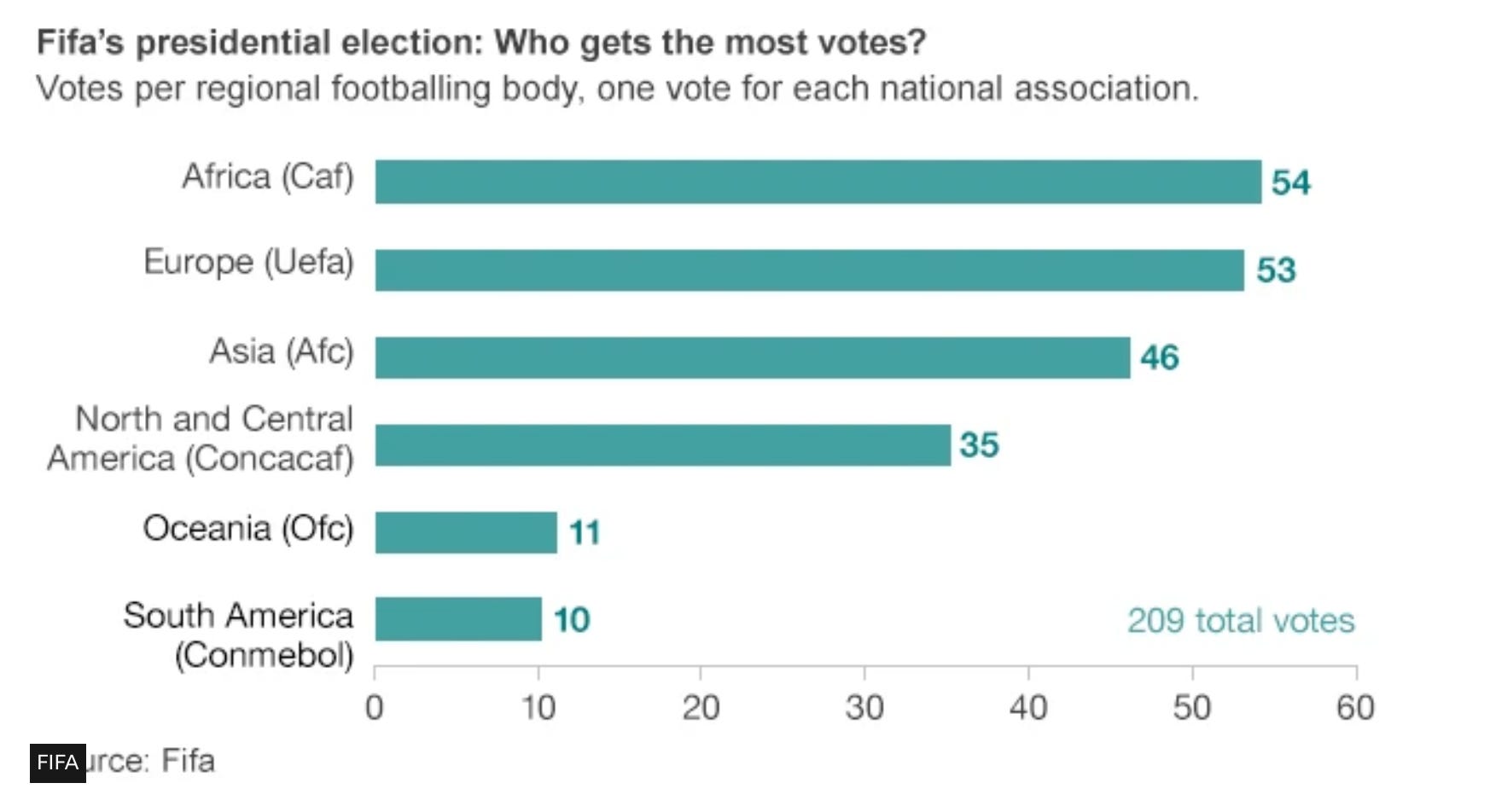
FIFA was founded in 1904, though it wasn’t until the late 20th century that its relevance and importance grew, along with the global popularity of the World Cup, which drew in billions of viewers (and dollars) by the turn of the 21st century. FIFA is composed of six federations, each of which is comprised of local football administrators from the member states that make up the federation: UEFA (Europe); CONMEBOL (South America); CONCACAF (North, Central America, and Caribbean); CAF (Africa); AFC (Asia and Australia); OFC (Oceania). The member states elect the organization’s president and the 37-member FIFA council. (Prior to 2015 FIFA had an “executive committee,” not a council, and it seems like its members were ALL dudes — after February 2016 each federation was required to elect at least one female member.)
The major vulnerability in FIFA’s governance structure is that every country gets one vote, meaning that the smallest Caribbean country has the same voting power as football giants like Brazil and Germany. While this is sort of democratic in theory, it also opened the door for corruption: Federations like CONCACAF and CAF had outsized voting power as a bloc compared to, say, CONMEBOL. In 1998, Sepp Blatter, then General Secretary, exploited this structure to get elected to the presidency over the favored European candidate that year through promises of financial assistance and alleged outright bribes to the countries in the poorer federations.
Now, FIFA’s already had an autocratic leadership structure and was rife with corruption: Blatter’s predecessor, João Havelange, had served for 24 years and had been taking bribes and kickbacks from outside companies for years. But Blatter took it to the next level, granting monopolies on TV rights and using the football assistance programs to line the pockets of federation heads, like CONCACAF President John Warner, in exchange for voting with (and for) him and getting the Caribbean member states to do the same. The corruption essentially became systematized throughout the organization, creating a pay-to-play (literally) scheme to the point where countries were essentially buying off the organization to host the World Cup — an allegation that came to a head when Qatar was selected as the host for the 2022 World Cup, over South Korea, Japan, Australia, and the United States. (Russia had previously won the bid to host in 2018, over Spain, Portugal, Netherlands, Belgium, and England.) Blatter served as president with an iron fist from 1998 to 2015 — basically he was the Godfather of FIFA.
In May 2015, the U.S. Justice Department unsealed a 47-count indictment charging fourteen defendants, including John Warner, with racketeering, money laundering, bribery, and wire fraud, among other charges. The indictment lays out the luxurious lifestyle that the FIFA members who participated in the scheme enjoyed (at the expense of the football program in their countries, which the money they received was ostensibly earmarked for.) For reasons that are still unclear to me, Blatter was not named in the indictment — he was also reelected as FIFA President TWO DAYS LATER! In fact, Blatter was not ever charged with any crimes (you might see where I’m going with the political parallels). Six months later, though, he was found to have engaged in misconduct and forced to step down, and is banned from participating in FIFA until 2027.
So what are some of the larger takeaways from this whole thing? A few things:
The Leader Makes Corruption the Norm
The story of FIFA is really one about how corruption is never confined to just a few people, especially if it is happening at the top: It eventually spreads through the entire organization. It of course spreads faster when the example is being set by the leader himself, because it effectively becomes the defining rules and culture of the organization itself. At that point, if you work in this kind of system — particularly if there is no accountability structure (see below) — you are faced with a choice to either get on board, or get out. To disrupt the status quo — say, by going to the police, or the media, who may or may not do anything, and may or may not be on the take themselves — puts you at great risk…at that point, too many people have too much to lose (like millions and billions of dollars), so they will do everything in their power to shut you up.
Corrupting FIFA wasn’t that difficult: It’s not like it was designed around a strong ethical compass to begin with. By contrast, an organization that already has a strong rule-abiding norm structure can potentially slow the spread of corruption down. For example, in the Justice Department, the FBI, and the military, where the constitutional oath is (was?) taken very seriously by most people, a corrupt leader will potentially encounter some resistance. But that’s just a speed bump: the project then becomes to first dismantle the existing norms (by purging people who won’t get on board and replacing them with loyalists) and then ensure that everyone knows the new “rules.” You still end up in the same place, and once corruption becomes endemic, undoing that culture becomes really, really difficult…more on that later.
Self-Policing Doesn’t Work
Part of the sense of impunity that FIFA members had prior to 2015 is that there was literally no external oversight on the body. Until 2012, FIFA had a single-chamber ethics committee whose members were hand-picked by the President of FIFA and the Executive Committee. Hmmm. Although the committee had the power to investigate matters on its own, in practice this was largely dictated by the President (and the findings could be buried if inconvenient). Hmmm. (The unraveling of the FIFA scandal is largely credited to an intrepid journalist named Andrew Jennings, described by The Washington Post as who you get when you “roll Bob Woodward and Carl Bernstein together, then add a touch of a Scottish burr and plenty of flannel.”)
We’re obviously seeing this play out in real time at the Justice Department and the FBI with, for example, the refusal to investigate the shootings into Renee Good or Alex Pretti, Signalgate, or pretty much anything else involving people within the administration. But we are also seeing it in the firings of inspectors general and the attempt to replace them with loyalists, like Trump’s most recent pick for the Justice Department IG, and the refusal of the Justice Department to provide a declaration to a federal district court that it does not plan to create a “weaponization fund.” Trump wants to turn the executive branch into a self-policing entity — for obvious reasons. (On this point, please see my post from a few weeks ago, We Need a Fourth Branch.)
But it’s also a larger issue that applies to the deregulation underway in the private sector, or to tech companies and AI, which continue to operate in a Wild West of no rules — except the ones they choose to make up themselves. What could go wrong?
The Right Punishment is Taking Away What They Value Most
The most disappointing part of the whole documentary was watching Smiley McSmile Sepp Blatter chatter away about his great leadership of FIFA — without ever getting caught in the criminal net for anything that happened on his watch. But it was sort of satisfying to see that he was banned from participating in FIFA — the organization that not only supported his lifestyle, but gave him his sense of identity and belonging — for two six years bans. He actually seemed pretty upset by that.
This brings me to a point I’ve been trying to make recently when talking about the American Reconstruction that will need to take place post-Trump. We must start thinking about accountability in ways that don’t necessarily involve criminal prosecution. Not because it isn’t warranted, but because it’s not realistic. Trump will, by and large, enjoy immunity for almost everything he has done in office. And he is most likely going to pardon his minions on their way out. So the question becomes, what other forms of punishment are still on the table, for him, and all of his enablers? I have written before about shame sanctions. But there is also professional discipline for those who hold licenses; civil forfeiture suits to claw back ill-gotten gains; impeachment or adjudication through yet-to-be created procedures for insurrectionists that leave them unable to hold office ever again. I love me an orange jumpsuit, but we have to think bigger, and more creatively.
Like me, you might be wondering what happened after the #@^&! went down in 2015. Well, several reforms were put in place to try to create more checks and balances within FIFA. But as I noted above, undoing a culture of corruption once it takes root is really, really difficult. In May of last year, a group of academics and Fair Square, an organization that represents 30 British football clubs, journalists, human rights activists, NGOs, and whistleblowers issued a joint statement arguing that these reforms have not been effective. The letter cites eight “failures,” including the conflicts of interest involving Blatter’s successor, Gianni Infantino, and the granting of the 2034 men’s World Cup to Saudi Arabia, concluding that FIFA is “arguably more poorly governed today than it was 10 years ago.” Some of the signatories had this to say:
‘This statement demonstrates not only the rank failure of the reforms enacted under the presidency of Gianni Infantino, but also the breadth of expert opposition to and frustration with FIFA’s dysfunctional governance model,’ said Nick McGeehan, the co-director of FairSquare, which coordinated the joint statement.
‘I was on the inside during the Blatter era, where wrongdoing was out in the open and the need for reform was not understood and certainly not welcome,’ said signatory Bonita Mersiades, who blew the whistle on FIFA misconduct after working on Australia’s bid for the 2018 and 2022 men’s World Cups. ‘The 2015 raids were a reckoning. But ten years on, while there may be process and policy in place under Gianni Infantino, the culture remains the same. And when it comes to process versus culture, culture wins every time. True reform demands more than new systems—it requires new values. We’re not there yet.’
Hear, hear. FIFA responded by saying it has “been able to change from a toxic organisation to a respected and trusted global sports governing body focusing on its mandate to develop football all around the world.” As proof of this transformation, FIFA pointed to the visit by then U.S. Attorney General Pam Bondi and FBI Director Kash Patel, “the very same authorities that had to intervene in FIFA in 2015,” and with whom it was working closely in the lead-up to this year’s World Cup.
[pause while you pick yourself off the ground after laughing uncontrollably]
I guess that tells us everything we need to know.
Bondi and Patel do make for a good laugh.
This was so powerful. And so good. You did a tremendous job. I want to get a quote to you. This sums up your whole piece. Sepp Blatter had a quote. I am the prince of Everybody!!!!!!!!!!!!