

The third book of Douglas Adams’ The Hitchhiker’s Guide to the Galaxy five-part trilogy introduces the concept of Somebody Else’s Problem (SEP). For those of you out there who have never read The Hitchhiker’s Guide, first, I’m sorry for you (go read it, ASAP!). Second, by way of explanation, it’s a satiric science fiction novel that follows an ordinary person named Arthur Dent on various adventures through the galaxy after he narrowly escapes the destruction of Earth. Among the many gadgets Arthur encounters is a low-tech cloak that creates an SEP forcefield around it, which works like this:
Somebody Else’s Problem field, or SEP, is a cheap, easy, and staggeringly useful way of safely protecting something from unwanted eyes. It can run almost indefinitely on a torch (flashlight)/9 volt battery, and is able to do so because it utilises a person’s natural tendency to ignore things they don’t easily accept, like, for example, aliens at a cricket match. Any object around which an S.E.P. is applied will cease to be noticed, because any problems one may have understanding it (and therefore accepting its existence) become Somebody Else’s. An object becomes not so much invisible as unnoticed.
I was reminded of the SEP as I read this Guardian article about Lesley Groff, Jeffrey Epstein’s executive assistant. Groff began working for Epstein in 2001 (and I think she might be the only person I have ever heard of in the world who got a job after posting their resume on Monster.com). A few years after she was hired by Epstein and Ghislaine Maxwell, her primary “office” was moved to his personal residence in New York, where apparently, the first thing you saw when you walked in was this sculpture:
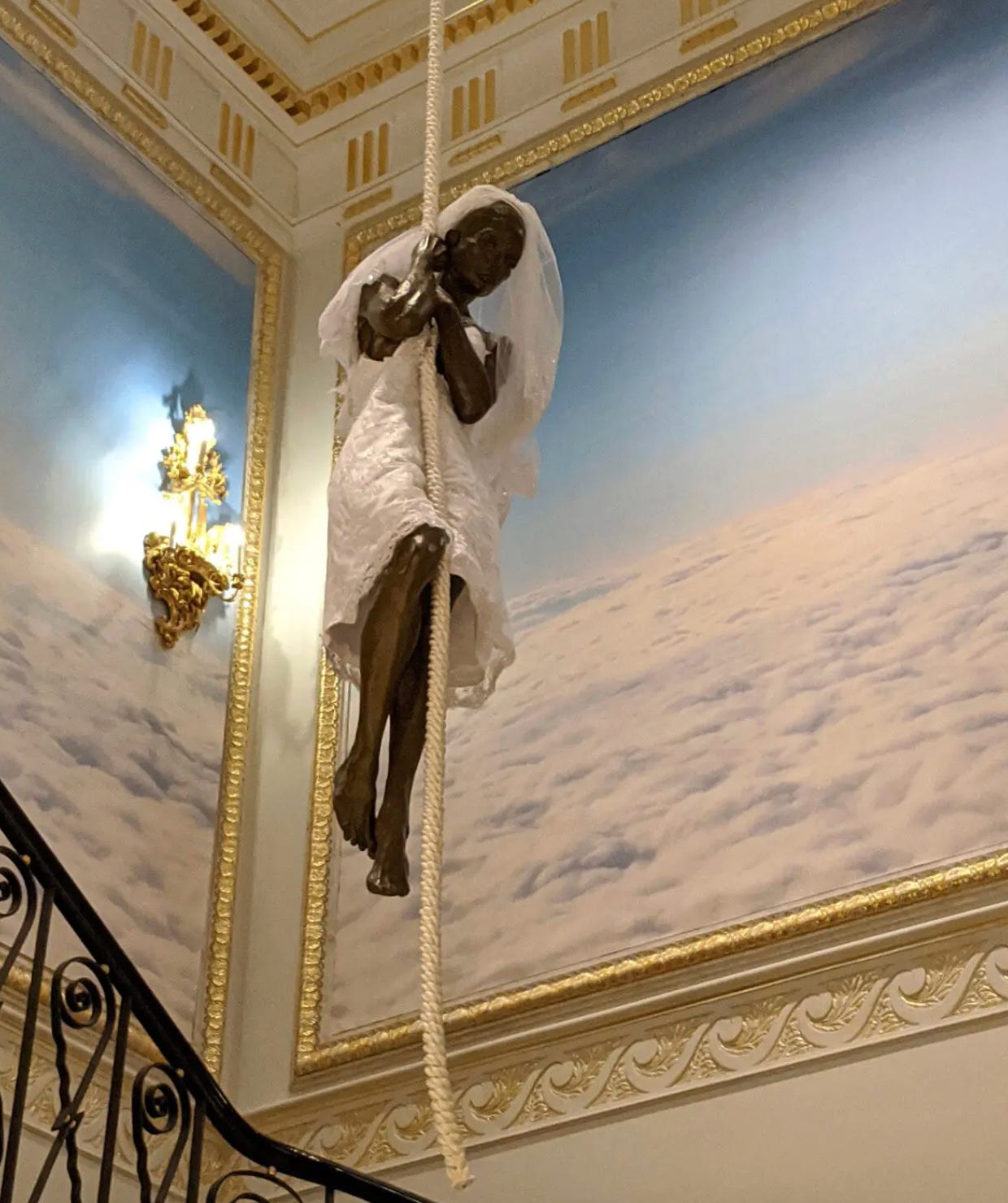
A child bride, trying to escape (something? someone?) down a rope? In the FBI, this is what we would call “a clue.”
Anyway, the article goes on to say that Groff was the linchpin for Epstein’s daily calendar, including, specifically, his daily “massages.” Her name appears more than anyone else in the Epstein files, more than 160,000 times. She is one of four people specifically named as immune from prosecution in Epstein’s 2008 “sweetheart deal” with the U.S. Attorney’s Office in Florida, overseen by Alexander Acosta. Sophie Elmhirst, the author of the Guardian piece, writes that “No one was more regularly in contact with Epstein, day-to-day.”
And yet, to this day, Groff maintains that she had no idea about the nature of Epstein’s sexual trafficking operation. To be sure, it sounds like her emails appear to be the kind you get from any good administrative assistant: cordial, professional, focused on details and logistics. There doesn’t seem to be any evidence that she and Epstein fraternized socially — she was apparently reprimanded once for even accepting a social invite from one of the many high-roller guests who visited Epstein — and his personal interactions with her seem to have been infrequent and curt. The highest salary she made was about $150,000, along with a few bonuses of several thousands dollars and some perks, like a paid Florida vacation or a spa day, that Epstein occasionally threw in.
Of course, the bread and butter of her job was arranging “meetings” between very obviously young girls and her boss. At times, when dealing with intermediaries who were bringing a girl to see Epstein, she put “your friend” in quotes — a seemingly weird thing to do if you genuinely believed someone was simply introducing their friend to Epstein. There were also indications in the emails that some of these “friends” were unwilling participants. Here’s one example:
Friend of victim: ‘Hey Lesley, My friend just got back, and I spoke to her now about tonight. She has never done anything of this sort before, and is a little nervous about the whole thing. I don’t know what Jeffrey has planned for tonight, but is it ok if they just meet this time? She would really feel more comfortable that way. If Jeffrey would rather not, its ok.. Let me know.’
Groff: ‘He says of course you can just stop by!!! :)’
Other emails show her navigating girls’ middle and high school schedules and afterschool activities. She even tracked down girls from Russia that Epstein apparently wanted to meet. I mean, Come. On.
I’ve written before about the many layers of complicity in the Epstein scandal. Groff falls in the category of “collaborators” — the functionaries who might not be the architects of the operation, but without whom the entire operation wouldn’t actually work. In this regard, Groff appears, on the surface, to be the epitome of Hannah Arendt’s conception of Adolf Eichmann’s “banality of evil”: a mid-level bureaucrat who just does what she’s told, without moral reflection. Eichmann, though, was apparently a more enthusiastic participant in Hitler’s ideological project than Arendt recognized. And Groff doesn’t entirely fit Arendt’s concept, either — she illustrates something harder to pinpoint.
In some ways, people like Groff are the most difficult to address in any complicit system. That’s because the primary architects, and the ones who are very obviously “on board” with their project, are the most actively involved and transparent about their motives. While incredibly dangerous if they are in positions of power, they are the most likely to actually get caught in the net of legal liability (as Epstein and Maxwell were), or face some sort of accountability for their actions. (See my post about FIFA’s corruption scandal, for example, or the social ostracization of the Sackler family and prosecutions against “pill mill” doctors who overprescribed opioids.)
Then there are those who enable — through action or inaction — out of fear. They worry that speaking up or taking a stand might cause them to lose their social circle, or their job, or something worse. What’s promising about this category of people is that they are actually grappling with the moral dilemma, and with the right incentives, they can be nudged to do the right thing. Things like bystander intervention training on college campuses to stop sexual assault is an example of this type of intervention.
Groff is in a no-man’s land: there’s no accountability mechanism or intervention that can address a willful ignorance (apart from therapy — see my talk with Dr. Alexander Stein on defense mechanisms). Groff didn’t benefit in the same many others did from being connected to Epstein — she wasn’t a high-flyer in his social circle. She also wasn’t afraid — there were absolutely no serious consequences if she had quit her job, for example. And she certainly wasn’t grappling with any moral dilemmas: who these girls were who were coming and going EVERY DAY, what Epstein was doing with them, why there were bizarre sculptures and photos all over his house. She just had a comfortable salary, got to renovate her house in CT, get the occasional vacation and spa day, and feel important.
The girls were Somebody Else’s Problem.
Thank you for this. I have encountered SEP not in people of power, who are actively complicit, but in ordinary neighbors, acquaintances who I suspect are causing as much damage to our resistance and fight against this fascist kleptocracy by their lack of critical thinking, low information and simplistic rationalization. Case in point: a conversation I had with a self-identified Christian neighbor who insisted the news reports about the horrors of ICE and administration’s antipathy for immigrants and people of color was exaggerated and sensationalist because he is acquainted with two families who are immigrants (one “brown”) who are doing fine and realizing what he sees as the “American Dream”. In the past I’ve tried offering a different perspective to him, along with news articles, Substack essays, and reports but his mind is closed. I wouldn’t say he’s a trump supporter but he’s clueless and not willing to participate in anything to even insure that his two immigrant families keep their good fortune.
Thank you Asha, you are star, shining even more brightly for citing Douglas Adams. Little seems to be known publicy about Groff's background. Was there anything in her early life that might have contributed to her conscious or unconscious acceptance or even normalisation of the horrors perpetrated by Epstein et al? As a key member of a staff team she would have been subject to what Zimbardo termed the "Lucifer Effect" (in relation to the Stanford Prison Experiment). Seeing Epstein hobnob easily with the likes of Andrew Mounbatten-Windsor (formally known as Prince) and Peter Mandelson (a Lord of the Realm, also known as the Prince of Darkness) would reinforce the notion of one rule for the rich and another for the rest of us. She might also have experienced Adams' Total Perspective Vortex -feeling insignificant alongside the Great and the (not) Good. (I get that feeling of insignificance when visiting the British Library.) For most ordinary people, learned heplessness is much more common rather than having the agency to pluck up the courage to blow the whistle with a high likelihood of being both unsuccessful and losing one's livelihood.
Not an excuse, but merely a hypothesis.